Location:
ChenDianHu Industrial Area, GanZhe Town, Minhou County,
Fuzhou City, Fujian Province, China
teruiermirror
The Mirror Looks Beautiful. The Shipment Still Fails: QC Checkpoints Every Buyer Should Review Before a Mirror Leaves the Factory
26-04-02 3 view
A mirror can photograph beautifully and still become a costly problem the moment it reaches the warehouse. That is the part many buyers learn too late. In the traditional mirror business, failure rarely starts with style. It starts with execution: reflective distortion, edge defects, frame color inconsistency, weak hanging hardware, damaged corners, or cartons that do not survive transit. A decorative wall mirror may look correct in a single showroom sample, yet fail in batch production when twenty, fifty, or two hundred pieces need to arrive in consistent condition. That is why serious buyers do not inspect mirrors only as décor. They inspect them as a repeatable product system. At Teruier, we believe mirror sourcing should not stop at shape, finish, and price. It should include a clear quality-control logic before shipment—especially for decorative wall mirrors, full-length mirrors, and floor mirrors, where appearance and structural safety must work together. Why mirror QC needs to be taken seriously There are industry specifications that matter. ASTM C1503 covers requirements for silvered flat glass mirrors, ASTM C1036 covers quality requirements for flat glass used in products including mirrors, and ASTM C1048 applies when heat-treated glass is involved. One especially important detail is that ASTM C1036 notes reflective distortion is not addressed there, which means buyers cannot rely on base material specifications alone; they still need factory-side visual and practical QC for real-world mirror performance. For shipping risk, ISTA transit testing exists to help verify packaging performance under distribution hazards. In other words, standards matter—but standards alone do not protect your shipment. A reliable supplier still needs an internal mirror QC checklist. 1. Check the mirror surface first, not the frame Buyers are often drawn to the frame finish first because that is what sells visually. But the first QC checkpoint should always be the mirror itself. Start with reflection clarity. Look for wave distortion, funhouse effects, and local surface irregularities. Then check for black edge risk, silvering defects, pinholes, scratches, cloudiness, and coating instability around the perimeter. In decorative mirrors, edge quality matters more than many buyers realize. A small edge defect may look minor in the factory, but after packaging, climate change, and warehouse handling, it can become a customer complaint. For rectangular wall mirrors and full-length mirrors, check the long-axis reflection carefully. Stand at multiple angles and verify that body proportions do not visually stretch or compress. This is especially important for retail mirrors, fitting-room mirrors, and bedroom floor mirrors, because end users immediately notice distortion even when they cannot explain it technically. A good mirror should not only be bright. It should feel visually stable. 2. Inspect edgework like a buyer who expects reorders Traditional mirrors are not judged only…
The Mirror Looks Beautiful. The Shipment Still Fails: QC Checkpoints Every Buyer Should Review Before a Mirror Leaves the Factory
The Mirror Looks Beautiful. The Shipment Still Fails: QC Checkpoints Every Buyer Should Review Before a Mirror Leaves the Factory
A mirror can photograph beautifully and still become a costly problem the moment it reaches the warehouse.
That is the part many buyers learn too late.
In the traditional mirror business, failure rarely starts with style. It starts with execution: reflective distortion, edge defects, frame color inconsistency, weak hanging hardware, damaged corners, or cartons that do not survive transit. A decorative wall mirror may look correct in a single showroom sample, yet fail in batch production when twenty, fifty, or two hundred pieces need to arrive in consistent condition.
That is why serious buyers do not inspect mirrors only as décor. They inspect them as a repeatable product system.
At Teruier, we believe mirror sourcing should not stop at shape, finish, and price. It should include a clear quality-control logic before shipment—especially for decorative wall mirrors, full-length mirrors, and floor mirrors, where appearance and structural safety must work together.
Why mirror QC needs to be taken seriously
There are industry specifications that matter. ASTM C1503 covers requirements for silvered flat glass mirrors, ASTM C1036 covers quality requirements for flat glass used in products including mirrors, and ASTM C1048 applies when heat-treated glass is involved. One especially important detail is that ASTM C1036 notes reflective distortion is not addressed there, which means buyers cannot rely on base material specifications alone; they still need factory-side visual and practical QC for real-world mirror performance. For shipping risk, ISTA transit testing exists to help verify packaging performance under distribution hazards.
In other words, standards matter—but standards alone do not protect your shipment.
A reliable supplier still needs an internal mirror QC checklist.
1. Check the mirror surface first, not the frame
Buyers are often drawn to the frame finish first because that is what sells visually. But the first QC checkpoint should always be the mirror itself.
Start with reflection clarity. Look for wave distortion, funhouse effects, and local surface irregularities. Then check for black edge risk, silvering defects, pinholes, scratches, cloudiness, and coating instability around the perimeter. In decorative mirrors, edge quality matters more than many buyers realize. A small edge defect may look minor in the factory, but after packaging, climate change, and warehouse handling, it can become a customer complaint.
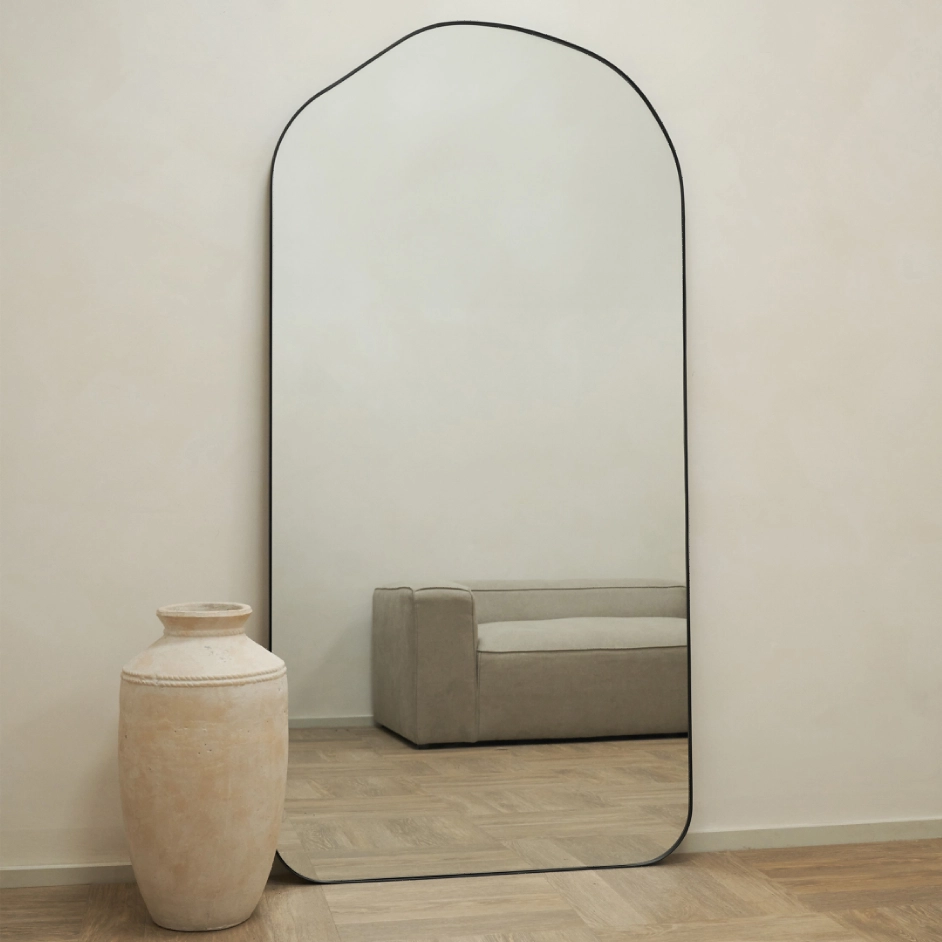
For rectangular wall mirrors and full-length mirrors, check the long-axis reflection carefully. Stand at multiple angles and verify that body proportions do not visually stretch or compress. This is especially important for retail mirrors, fitting-room mirrors, and bedroom floor mirrors, because end users immediately notice distortion even when they cannot explain it technically.
A good mirror should not only be bright. It should feel visually stable.
2. Inspect edgework like a buyer who expects reorders
Traditional mirrors are not judged only by what the customer sees from the front. They are judged by how consistently they survive reorders.
That is why edgework deserves its own QC step.
Check whether the edges are polished cleanly, seamed properly, and free of chips. If the design includes beveling, make sure the bevel width is even from piece to piece. Uneven bevels quickly make a batch look cheap. On framed mirrors, confirm that hidden edge treatment is still controlled. Sloppy hidden edges often create later failures in assembly or transport.
For buyers building a long-term SKU program, this matters even more than the first shipment. Bad edge consistency is one of the most common reasons a successful mirror sample becomes an unstable repeat order.
3. Frame quality is where “looks expensive” often breaks down
In traditional mirrors, the frame is not decoration alone. It is also the product’s main signal of perceived value.
For metal-framed mirrors, inspect welding smoothness, corner alignment, finish consistency, brushed direction, plating uniformity, and coating adhesion. Gold, bronze, black, antique brass, and champagne finishes all need special attention because inconsistency is obvious under showroom lighting.
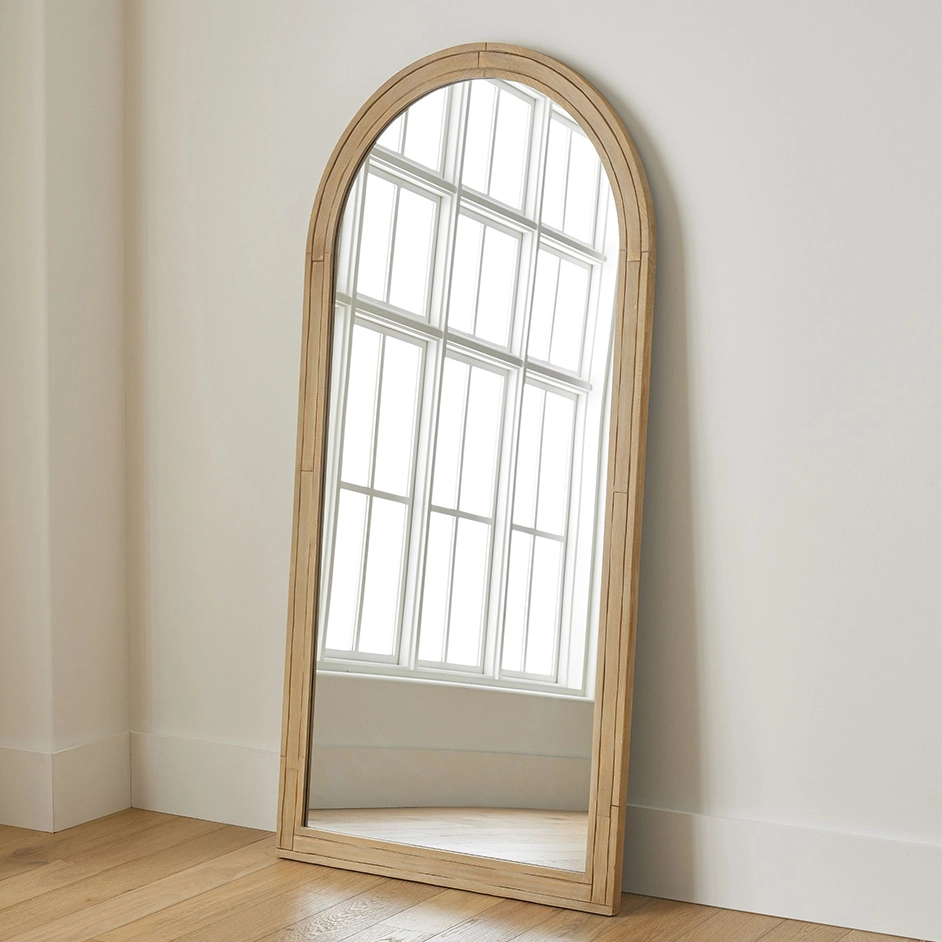
For wood-framed mirrors, check joint precision, veneer matching, wood tone consistency, paint coverage, grain direction, and touch feel along edges and corners. A mirror may photograph well from the front and still fail in person because the joinery feels rough or the stain shifts from one production batch to another.
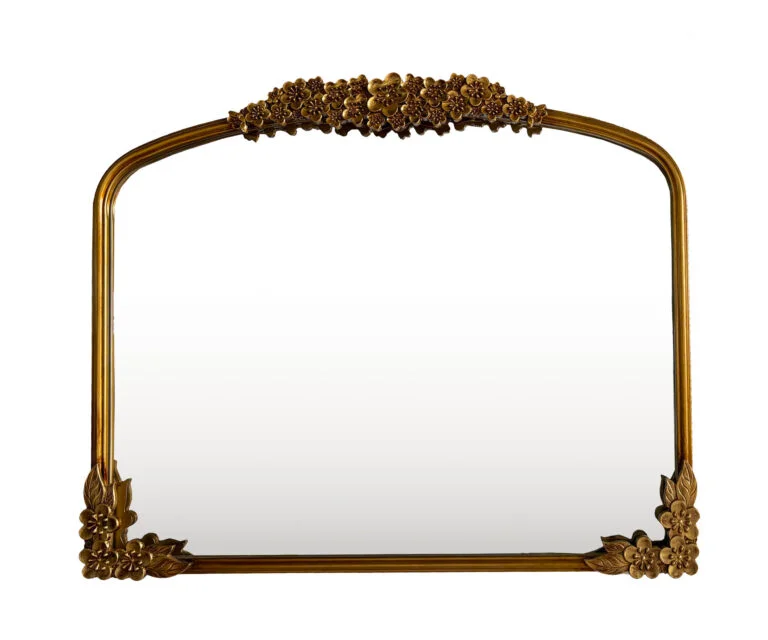
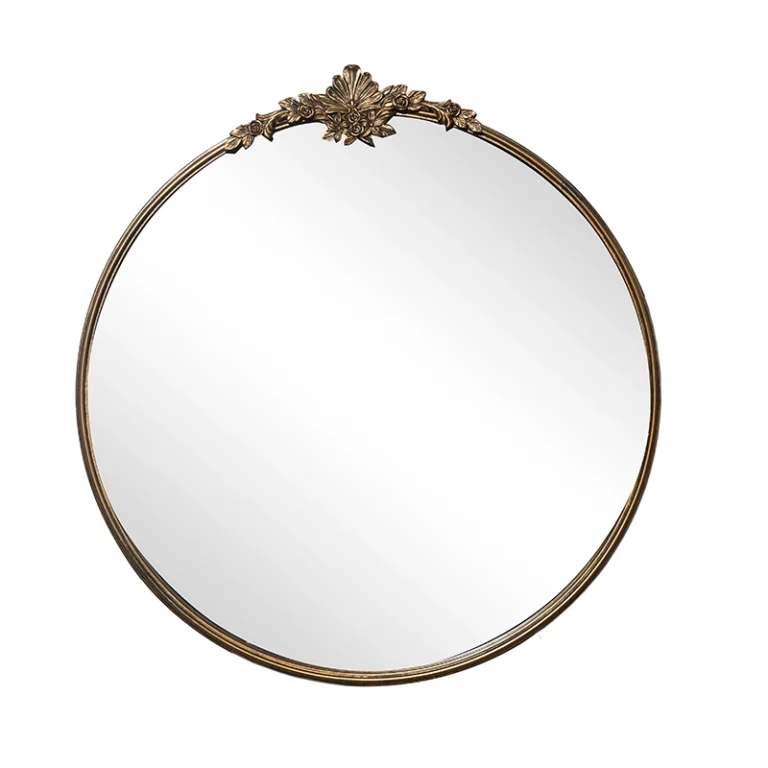
For ornate or carved decorative mirrors, inspect depth consistency and surface cleanliness inside grooves, corners, and relief details. Complex designs hide defects easily in the factory and reveal them clearly in retail.
If the frame finish is your margin, then frame QC is your profit protection.
4. Hanging hardware is not a minor accessory
Many mirror problems are not caused by the mirror face. They are caused by the back.
A decorative wall mirror with poor rear construction is a return waiting to happen.
Check the MDF or backboard fit, reinforcement method, screw positioning, D-rings, hooks, hanging plates, and load distribution. Confirm whether the mirror is designed for vertical hanging, horizontal hanging, or both. If both are promised, both should be tested.
For full-length mirrors and heavy wall mirrors, hardware positioning must match the center of gravity. Buyers should also confirm whether the supplier has tested actual hanging stability rather than simply attaching hardware as a standard accessory.
For floor mirrors and leaning mirrors, inspect support legs, hinges, anti-tip logic, leg angle consistency, and opening-stop reliability. A beautiful floor mirror that feels unstable on the sales floor will kill buyer confidence immediately.
5. Size, tolerance, and symmetry must be checked in batch—not only in sample
A single sample can hide production weakness.
That is why dimensional QC should be based on batch logic.
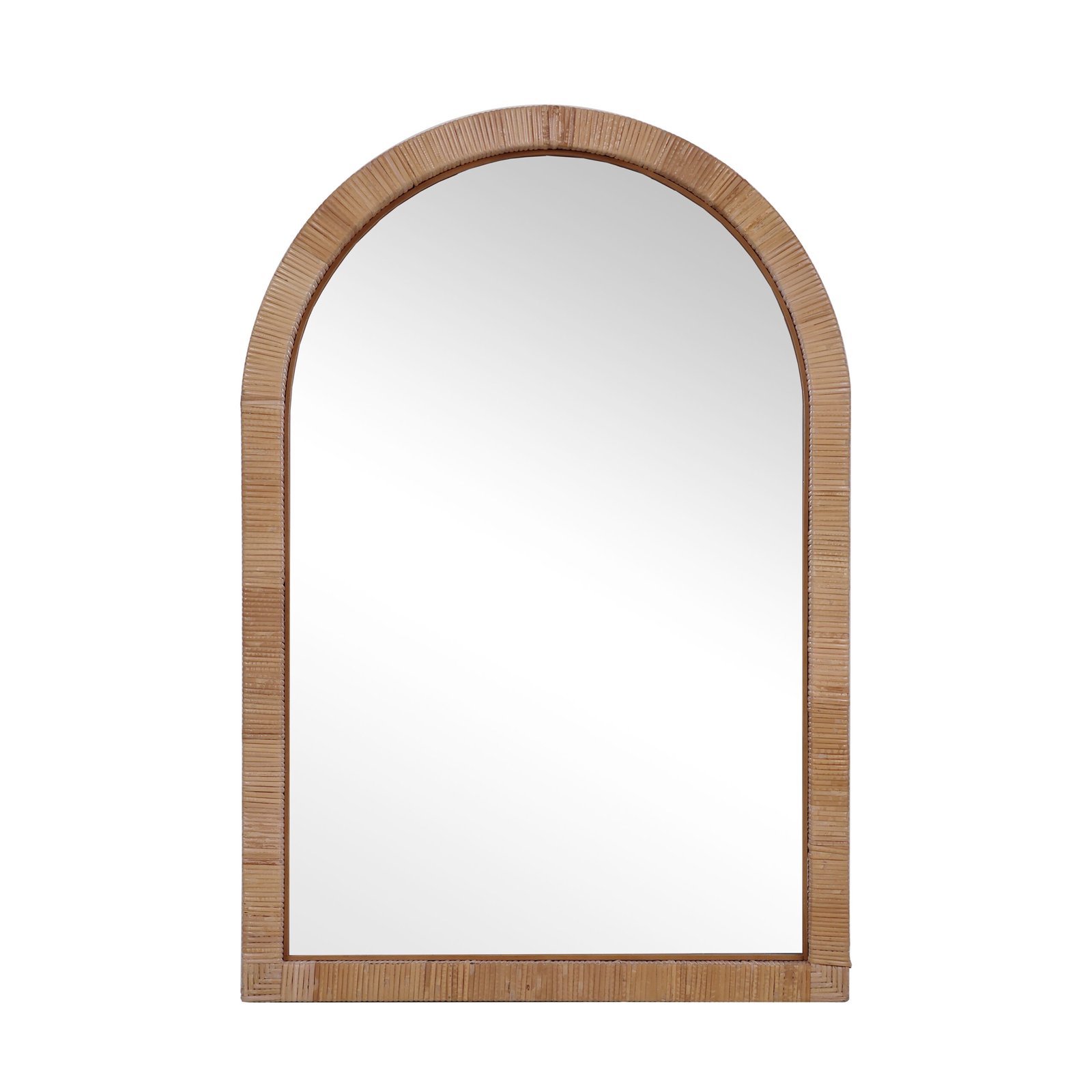
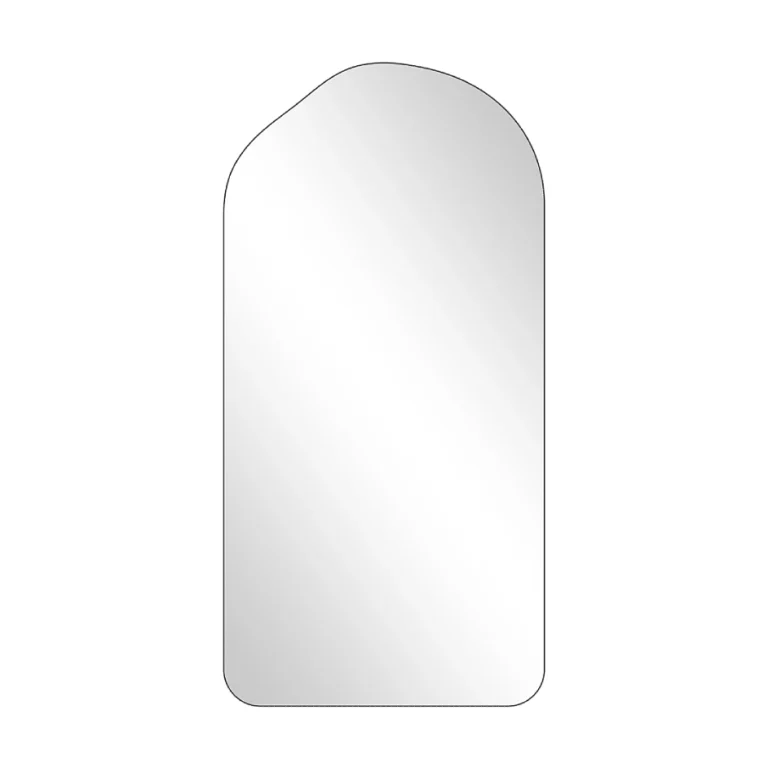
Check overall dimensions, mirror area dimensions, frame width consistency, diagonal symmetry, corner alignment, and thickness consistency. On arched mirrors and shaped mirrors, verify that the curve profile matches the approved sample. On paired designs or mirror sets, confirm whether the left and right pieces feel visually balanced when placed together.
This is where many factories underperform. They can make a good-looking individual mirror. They cannot always make fifty mirrors that look like they belong to the same program.
Buyers should never approve a traditional mirror collection on aesthetic language alone. They should approve it on repeatability.
6. Packaging is part of QC, not a separate afterthought
For mirrors, packaging is product protection.
That means packaging must be inspected with the same seriousness as the frame and glass.
Check corner protection, face protection, back protection, carton wall strength, internal cushioning, movement control inside the carton, and whether the pack-out matches the mirror’s size and weight. Large wall mirrors and full-length mirrors should never rely on generic carton logic. The packaging needs to reflect size, breakage risk, and handling reality.
Transit testing standards such as ISTA exist because distribution damage is predictable enough to simulate. That is exactly the mindset buyers should expect from a serious mirror supplier: not “we packed it,” but “we designed packaging around the risk.”
For import buyers, it is also worth checking carton markings, orientation labels, pallet logic where applicable, and whether replacement risk has been considered in the pack design. A mirror that survives factory inspection but fails container-to-warehouse movement is still a failed product.
7. Batch consistency is the real test of factory quality
The first piece proves possibility. The batch proves capability.
That is why pre-shipment QC should always compare production against the approved sample, not just against a generic specification. Color tone, finish texture, frame width, mirror brightness, hardware placement, and packaging method all need to match the sample standard the buyer actually approved.
At Teruier, this is the difference between selling a mirror and building a reorder-ready mirror program.
A buyer does not need one good piece. A buyer needs a supplier that can make the twentieth carton feel as safe as the first.
8. The most useful questions buyers should ask before shipment
Before approving shipment, buyers should ask suppliers questions like these:
Is the mirror glass standard consistent across the whole batch?
Has reflective distortion been visually checked, not just dimensionally checked?
Are the frame corners and finish matched to the approved sample?
Has the hanging hardware been load-checked?
Has packaging been adapted to this size and weight, or is it generic?
Are photos available for front view, side profile, back construction, and packed carton?
What defects are considered rejectable in pre-shipment inspection?
If a reorder happens in 60 or 90 days, how will finish consistency be maintained?
These questions do not slow business down. They make future business possible.
9. What strong mirror QC says about a supplier
A factory that talks only about design usually wants the order.
A factory that talks clearly about QC usually wants the reorder.
That is the difference serious buyers should pay attention to.
At Teruier, we see decorative mirrors, wall mirrors, and full-length mirrors not only as visual products, but as execution products. Good mirror sourcing is not only about trend alignment. It is about whether the mirror arrives straight, safe, consistent, and ready to sell.
Because in the end, the mirror does not fail when it looks bad in a catalog.
It fails when the buyer cannot reorder with confidence.
A Mirror Can Look Beautiful in Photos and Still Fail in Shipment: The QC Checkpoints Buyers Should Review Before Approval 2026-04-02
A mirror can look perfect in a product photo and still become a problem the moment it reaches the warehouse.
That is the mistake many buyers make.
They approve the style. They approve the finish. They approve the sample photo. But they do not approve the product as a repeatable shipment-ready item.
For decorative wall mirrors, floor mirrors, and full-length mirrors, the real question is not only whether the mirror looks attractive. The real question is whether it can survive production, packing, transport, unloading, and final display without creating complaints, replacements, or margin loss.
That is why mirror sourcing should always include clear mirror QC checkpoints.
Why mirror quality control matters more in traditional mirrors
With traditional mirrors, buyers are not only buying reflection. They are buying finish quality, structural consistency, and visual trust.
A small defect in a metal frame corner can lower the entire product grade. A slight wave in the mirror surface can make a full-length mirror feel cheap. A weak hanging bracket can turn a decorative wall mirror into a liability. A poor carton structure can destroy a floor mirror before it even reaches the customer.
In other words, traditional mirrors are highly visual products—but they fail through execution.
That is exactly why a proper mirror inspection checklist matters.
1. Start with the mirror surface, not the styling
The first checkpoint is the reflection itself.
Before discussing frame color, shape trend, or decorative details, buyers should inspect the glass surface carefully.
Look for:
reflection distortion
scratches
pinholes
black edge risk
cloudy spots
inconsistent mirror backing
visible defects near the perimeter
This is especially important in full-length mirror QC, because customers notice body distortion immediately. A mirror may still look “acceptable” on a warehouse floor, but once it is used in a bedroom, fitting room, or retail display, distortion becomes obvious.
If the reflection does not feel stable, the mirror is not ready.
2. Check frame construction as a value signal
In traditional mirrors, the frame is not a secondary part. It is often the reason the buyer chose the item in the first place.
For metal-framed mirrors, inspect:
corner welding
joint alignment
coating consistency
brushed finish direction
surface scratches
plating uniformity
For wood-framed mirrors, inspect:
color consistency
veneer matching
corner joining quality
paint coverage
rough sanding marks
edge smoothness
This is where a strong wall mirror quality control process becomes important.
A wall mirror is often judged from distance first and up close second. If the frame looks good from afar but feels rough, uneven, or poorly aligned when handled, the buyer loses confidence immediately.
3. Hanging hardware is part of product quality
A mirror is not finished when the front side looks good.
The back side decides whether it can actually be sold safely.
Every decorative mirror inspection checklist should include:
D-ring placement
hook alignment
screw fixing
backboard attachment
support strength
horizontal/vertical hanging readiness
stability under actual weight
For heavy decorative wall mirrors, buyers should also confirm whether hardware positioning matches the center of gravity. A mirror that hangs unevenly or feels insecure will create installation complaints very quickly.
For floor mirrors and leaning mirrors, inspect the support leg, opening angle, hinge stability, and anti-tip logic. These are not small details. They directly affect retail usability and return risk.
4. Batch consistency matters more than sample beauty
A good sample proves possibility. A good batch proves capability.
This is where many suppliers break down.
The approved sample may look excellent, but the batch may show:
inconsistent frame tone
different gold or black finish shades
uneven bevel effect
changing mirror brightness
different corner craftsmanship
unstable packaging method
So before shipment approval, buyers should compare production against the approved sample in a structured way.
That is what real mirror QC checkpoints are for.
5. Packaging should be inspected as seriously as the mirror itself
For mirrors, packaging is not an afterthought. It is product protection.
This is especially true for large wall mirrors and floor mirrors. A good mirror can still arrive broken if the packaging system is weak.
A practical floor mirror packaging inspection should include:
corner protection strength
front and back panel protection
carton wall strength
internal movement control
shock absorption materials
carton fit to product size
clear handling and orientation marks
For large-format mirrors, the packaging should never feel generic. If the carton design looks like a standard box applied to a fragile oversized item, the buyer should assume avoidable risk exists.
6. Dimensional control should be part of QC
The mirror may be stylish, but if the dimensions drift, the product loses commercial value.
Check:
total height and width
frame width consistency
thickness stability
diagonal balance
arch or curve symmetry
pair matching for set items
This is often ignored in basic inspections, yet it is one of the easiest ways to detect whether a factory is controlling production well or simply assembling attractive samples.
7. A good buyer asks quality questions before shipment
Before approving mirror production for shipment, buyers should ask:
Has reflection distortion been visually checked?
Are all frame corners aligned consistently?
Does the finish match the approved sample batch-wide?
Has the hanging hardware been tested?
Has the packaging been adjusted for this mirror size?
Are pre-shipment photos available for front, side, back, and packed condition?
What defects are considered rejectable?
How will consistency be controlled in reorders?
These questions do not make the buying process slower.
They make it safer.
8. What strong mirror QC says about a supplier
A supplier that only shows design understands selling.
A supplier that shows process understands repeat business.
That is the difference buyers should care about.
At Teruier, we believe traditional mirrors should be managed not just as décor products, but as deliverable products. A mirror must not only look right in a collection. It must also arrive right, hang right, and reorder right.
Because for buyers, the shipment is not successful when the mirror looks beautiful in a brochure.
The shipment is successful when the mirror arrives with confidence built in.
Generally speaking, our order requirements are as follows: the minimum order quantity (MOQ) for large items is 50 pieces, for regular items it is 100 pieces, for small items it is 500 pieces, and for very small items (such as ceramic decorations) the MOQ is 1,000 pieces. Orders exceeding $100,000 will receive a 5% discount. The delivery timeline is determined based on the specific order quantity and production schedule. Typically, we are able to complete delivery within two months.






























Leave a Reply